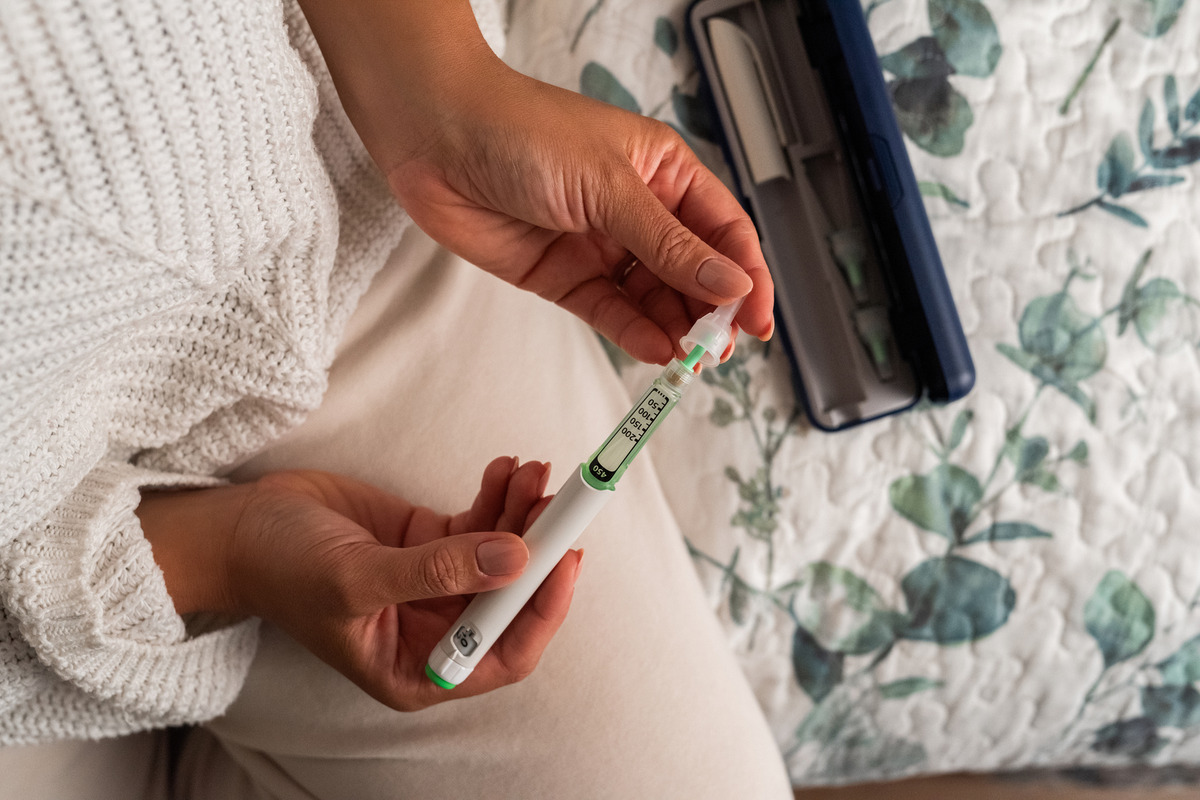
.jpg)

Key Takeaways
- Zepbound® is FDA-approved, meaning it has been rigorously tested for safety, effectiveness, and consistent manufacturing.
- Without FDA oversight, compounded versions can vary in ingredient quality and dose accuracy, meaning you may not get the treatment you expect.
- When insurance covers the medication, Zepbound® can be surprisingly affordable, making the tradeoff in reliability hard to justify.
To understand how weight loss medications work, it helps to know the difference between an active ingredient and a brand name. From a functional standpoint, Zepbound® is the same as tirzepatide. Tirzepatide is the active ingredient that helps regulate blood sugar and reduce appetite. Zepbound® is a retail brand name for a drug containing tirzepatide.
Clinical trials show that people taking tirzepatide lose an average of 16–22.5% of their body weight over 72 weeks. This remarkable data caused a surge in global demand that outpaced manufacturing capacity. The resulting historic supply shortages carved out a temporary secondary market for compounded tirzepatide.
Compounded tirzepatide is a custom-mixed alternative to the branded medications. Specialized compounding pharmacies prepare it from scratch. It’s important to note that compounded tirzepatide isn’t widely available to the general public. FDA-approved GLP-1 medications remain the standard path for treatment.
Read on to learn more about Zepbound® versus compounded tirzepatide and when doctors prescribe each.
What’s tirzepatide, and what does it do?
As a dual GIP/GLP-1 receptor agonist (GLP-1 RA), tirzepatide mimics two natural gut hormones to manage blood sugar and quiet your brain’s hunger signals. This makes it a highly effective treatment for both weight loss and type 2 diabetes by targeting two specific hormone pathways in the body:
- Glucose-dependent insulinotropic polypeptide (GIP) works directly on your fat cells and insulin pathways. It changes how your body stores and breaks down energy, improving insulin sensitivity and helping your body metabolize fat more easily.
- Glucagon-like peptide-1 (GLP-1) primarily works in your digestive tract and brain. First, it slows down how fast your stomach empties to keep you physically fuller for longer. Second, it directly signals your brain to turn off hunger cues.
What’s the difference between Zepbound® and compounded tirzepatide?
Compounded versions claim to have the same active ingredient and efficacy. However, specialized pharmacies mix the compounded version from scratch. Because pharmacists customize each batch, the final product can vary in its dose strength or inactive ingredients used to mix the medication.
The regulatory picture: What changed, and what does it mean for you?
A surge in demand for GLP-1 medications landed tirzepatide on the FDA’s official drug shortage list in December 2022. Mounjaro®, the first FDA-approved tirzepatide for type 2 diabetes, triggered the initial shortage. A massive wave of off-label prescriptions for weight loss outpaced manufacturing capacity. The FDA officially approved Zepbound® for chronic weight management in late 2023. While this boost in manufacturing brought more supply to the market, consumer demand rose even faster.
Under federal law, an active FDA shortage list designation temporarily allows compounding pharmacies to mass-produce copies of patented drugs. So, compounding pharmacies began legally producing compounded tirzepatide to meet demand.
When the FDA officially resolved the shortage in late 2024, that special exception expired. This led many to ask, “With the shortage now over, is compounded tirzepatide banned?” The short answer is no, but the rules are much stricter.
Today, pharmacies can only make compounded tirzepatide if a doctor proves that the brand name drug won’t work for a patient. For example, a doctor might prescribe a compounded version if a patient suffers from a severe allergy to an inactive ingredient in Zepbound®.
This comparison chart compares the manufacturing, regulation, and pricing of Zepbound® and compounded tirzepatide:
Quality and cost: Where compounded and FDA-approved options differ the most
Compounded tirzepatide typically costs less than brand name Zepbound®. However, finding the right option requires a clear look at the actual math. Affordability drives many patients to consider custom-mixed alternatives. However, you still need a valid prescription for these alternatives, and a licensed compounding pharmacy must fill them. Capturing cost savings requires balancing significant clinical risks.
Cost breakdown
Out-of-pocket costs for tirzepatide depend almost entirely on your specific insurance situation and how you choose to source the medication:
- With insurance: If your commercial insurance covers Zepbound®, or if you qualify for the manufacturer’s savings card, your out-of-pocket cost can drop to as little as $25 per month. In this scenario, the FDA approved brand name is both the safest and the most affordable choice.
- Without insurance: If your insurance excludes weight loss medications, Zepbound’s® out-of-pocket retail price typically ranges from $299 to $699 per month, depending on your dosage and pharmacy programs.
- The compounded route: Because health insurance plans rarely cover compounded tirzepatide, you must pay entirely out-of-pocket. Compounding pharmacies typically offer a predictable flat rate, typically ranging between $299 and $399 per month.
While the flat-rate pricing of compounding pharmacies looks attractive if you lack insurance coverage, you must weigh those savings against many safety concerns.
What are the safety concerns with compounded tirzepatide?
To get FDA approval for Zepbound®, Eli Lilly had to prove the drug was safe, effective, and consistently manufactured through large-scale clinical trials (the SURMOUNT program). Compounded versions face a different process. Instead of checking the individual medication, federal law only regulates the type of facility mixing it. While these pharmacies must follow specific quality standards, the FDA doesn’t test or review individual compounded products for safety before they hit the market.
This limited oversight and lack of FDA approval exposes patients to several clinical risks:
- Contamination and impurities: Federal regulators and manufacturers documented critical sterility failures in compounded formulations during laboratory testing. In one instance, the FDA issued a warning to a California compounding facility for using non-sterile ingredients. This practice creates a risk of life-threatening infections. Additionally, laboratory evaluations by Eli Lilly discovered bacterial contamination and chemical impurities in various unverified products marketed as tirzepatide.
- Ingredient integrity: The FDA actively monitors a growing black market of illegal tirzepatide products that lack the active ingredient entirely or contain incorrect or harmful ingredients. In multiple instances, tested samples contained zero active medication despite marketing claims. For example, chemical analysis by Eli Lilly revealed that one counterfeit batch distributed online contained nothing but sugar alcohol instead of tirzepatide.
- Dosing and measurement errors: Because compounding pharmacies mix these formulations individually, a small math or measuring error can alter the final strength. Patients may inadvertently receive a dose that’s too weak to work or too potent, increasing the risk of side effects like nausea and dehydration.
- Adverse events: The FDA identified more than 900 cases of adverse health events linked directly to compounded tirzepatide and semaglutide, including at least 17 confirmed patient deaths.*
- Alternative delivery forms: The FDA only approves authentic tirzepatide as an under-the-skin (subcutaneous) injection. Some pharmacies bypass this medical guideline by selling alternative formats like oral tablets and nasal sprays. These delivery methods lack FDA safety or absorption evaluations.
*Reported figures may undercount actual adverse events. Federal law doesn’t require compounding pharmacies to report adverse reactions to the FDA database. Because of this loophole, the federal database misses many state-level health complications.
Get safe, FDA-approved GLP-1 care with Maven Clinic
At Maven Clinic, your safety is our priority. We don’t prescribe compounded tirzepatide. We only prescribe FDA-approved medications, including Zepbound®.
Because we stick strictly to brand name medications, we know cost can be a concern. Our clinical team can help you navigate insurance coverage to find an affordable path forward. If your plan doesn’t cover weight loss medications, we offer self-pay options with no markup on medication costs.
Ready to start your GLP-1 care journey? To find out more, read about our approach to whole-person care.

"My clinician covered things I hadn't thought to ask, like how GLP-1s can affect birth control. I felt like I was making an informed decision instead of just following a trend."

"There's so much noise online, and I wanted someone I could actually trust. With Maven, I understood my options, why I was taking what I was taking, and what to expect before I ever started. It felt clear from day one."

"I tried a GLP-1 through another service first. Got the prescription, got nothing else. I'm in my late 40s, my body was changing, and I was asking AI my follow-up questions. Maven was the first time I had a clinician who knew what was going on with me and helped me feel like me again."
FAQ
Is compounded tirzepatide safe?
Compounded tirzepatide carries inherent clinical risk because it bypasses the safety, efficacy, and stability reviews the FDA enforces for brand name drugs. Because quality can vary widely by pharmacy, the FDA advises doctors to only prescribe compounded tirzepatide when an FDA-approved medication can’t meet the patient’s specific medical needs.
Is Zepbound® better than tirzepatide?
They are not separate treatments. Tirzepatide is the active ingredient in the branded medication, Zepbound®.
Can I switch from compounded tirzepatide to Zepbound® without starting the dose schedule over?
Transitioning between formulations differs on a case-by-case basis. Your clinician will evaluate your current dosage, tolerance, and medical history to determine the safest and most appropriate transition plan for your body.
What is the difference between Mounjaro® and compounded tirzepatide?
The relationship is similar to that of Zepbound® and compounded tirzepatide. Eli Lilly manufactures Mounjaro®, an FDA-approved medication indicated specifically for treating type 2 diabetes. Tirzepatide is its active ingredient.
While compounded tirzepatide reports to contains the same active ingredient as Mounjaro®, it is not FDA approved. Large-scale trials validated Mounjaro’s safety and efficacy. Compounded tirzepatide has no equivalent review.



.jpg)