.svg)
Summary
Open enrollment communication can feel overwhelming, but it doesn’t have to be. Our toolkit of customizable email templates simplifies the communication process for HR leaders.
Open enrollment is one of the highest-stakes communications moments of the HR calendar. The decisions employees make in a two-to-four-week window determine their healthcare coverage, out-of-pocket costs, and access to benefits they may not use until they really need them.
But even when you've built a genuinely strong benefits package, getting employees to engage with it is a different problem entirely. You can't make people read an email. You can't force them to log into a portal. And when open enrollment and benefit communications are vague, institutional, or easy to ignore, employees make uninformed decisions — or no decision at all.
Unused benefits aren't just a waste of spend. They're a retention and engagement signal: employees who don't know what they have don't feel taken care of.
This toolkit is built to close that gap. Use these free and available-to-anyone templates to write communications employees actually read, at every stage of the enrollment window. Stay on top of challenges at every step of the process, and be prepared to answer commonly asked questions so employees don’t fall through the cracks. Whether you work with Maven today or are exploring your options, take advantage of all the resources, right here.
A communications timeline that works
Effective open enrollment communication starts well before enrollment opens and continues through the close. Use this timeline to sequence your outreach, then access the full template library below.
The complete template library
Navigating open enrollment is a challenge for HR leaders and employees alike.
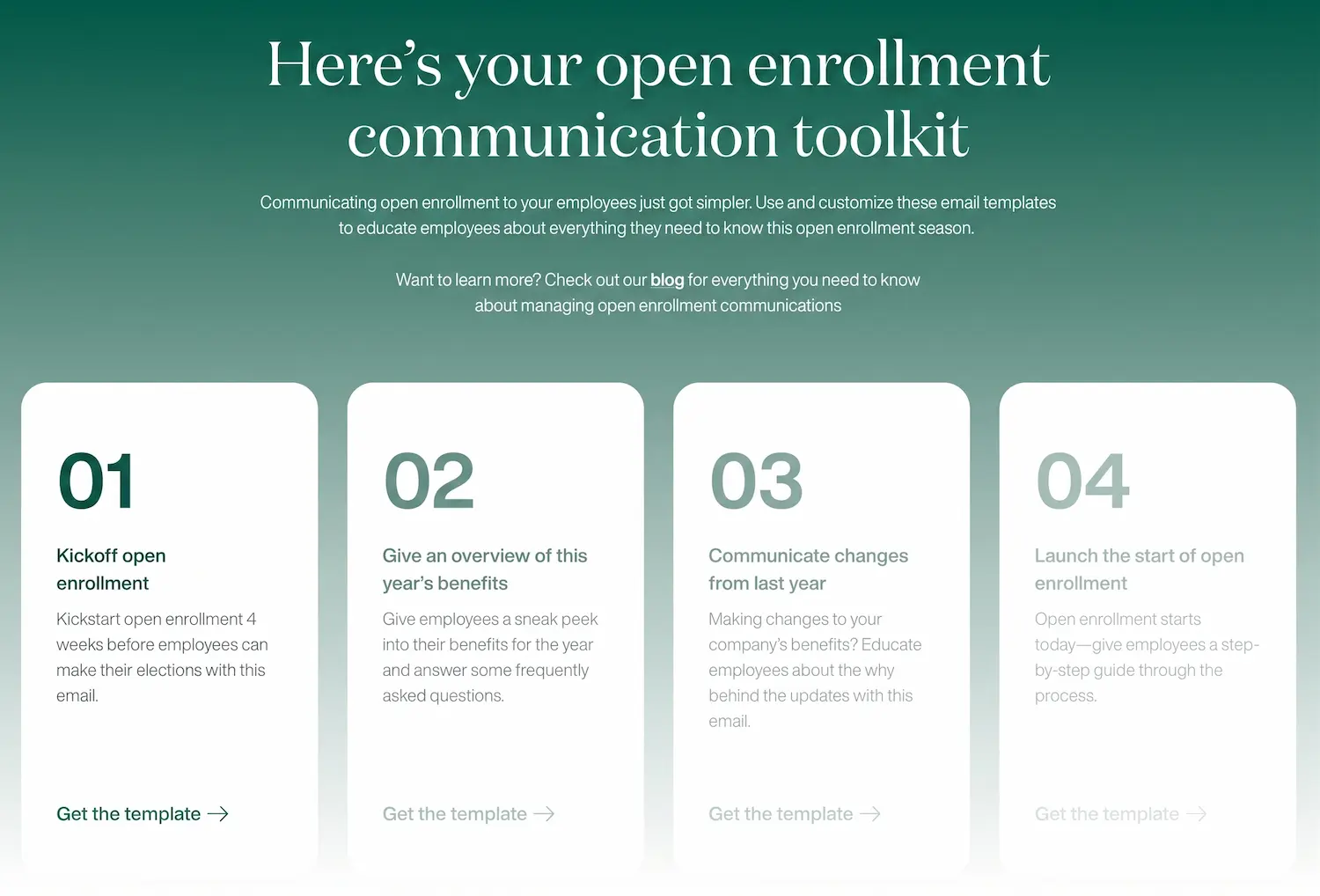
The seven email templates, along with Slack/Teams message templates and intranet messaging are designed to communicate clearly at each stage of the enrollment window, drive action, and reduce the volume of questions your team has to field.
What a great communications strategy looks like — before and after
The single most common reason open enrollment emails get ignored: they lead with the process, not the person.
Here's what that looks like in practice:
Before — weak opener:
"We're excited to kick off open enrollment for [YEAR]. Employees are encouraged to carefully review their benefits options and make selections before the deadline. Please don't hesitate to reach out if you have any questions."
After — strong opener:
"You have two weeks to lock in benefits that could save you thousands — or cost you if you overlook them. Here's what to know before [DATE]."
The revised version names the stakes, addresses the employee directly, and creates urgency in two sentences. The original is accurate but forgettable — and forgettable benefits communications get ignored, which defeats the entire purpose.
Every template in this toolkit applies the same principle: lead with what matters to the employee, not the administrative process.
Five tips for smooth open enrollment communications
Kathleen Davin, Director of People Operations at Maven Clinic, shares her top five tips for effective communication during this open enrollment period.
Tip #1: Be upfront about any changes
The first thing that Davin recommends is figuring out any changes to benefits—and communicating them in a clear, concise way. “Make sure you’re sharing with the full team about what changed,” says Davin. “You have to make sure those changes are crystal clear, with open enrollment communication that is approachable and easy to understand.”
These communications can involve presentations during company-wide meetings, office hours, and emails with clear calls to action. This may seem like overkill, but consistent, straightforward delivery is essential, as nearly one-third of American workers admitted they do not fully understand the employee benefits they selected during their most recent open enrollment process.
Tip #2: Set clear deadlines early and communicate them often
A successful open enrollment process requires a detailed timeline from the first reminder to the final deadlines. “I recommend making a decision-making flowchart telling people, ‘If you want to make a change this year, here’s what to do by this date,’” says Davin. “It ensures people are hitting all the deadlines in the process.”
Most HR professionals advise giving teams between two to four weeks to look at their choices and make their selections. By communicating clear timelines and deadlines frequently, you can ensure that all changes are submitted on time.
Tip #3: Personalize employee benefits communication
After sending open enrollment communication to the whole team, it’s time to sit down with team members individually and talk through their options. “One-on-one office hours are very effective during open enrollment, as HR teams can work with employees to see how this personally affects them,” explains Davin. “Benefits are very personal to people.”
One-on-one communication also ensures that any questions can be answered and employees can use their benefits to their fullest potential. A lack of benefits utilization may be an issue employees aren’t even aware of—according to a 2022 survey by Voya Financial, less than half of benefit-eligible employees actually took advantage of the benefit coverage offered by their employers.
“It’s important that people feel taken care of throughout the process and know it’s going on,” says Davin. “You have to follow up with people on how they are impacted individually.”
Tip #4: Create a hub for resources
It may take time for employees to feel fully educated on their benefits, as a comprehensive understanding of benefits develops throughout the year, not just during open enrollment. “During open enrollment, employees are making a decision that is going to be relevant all year,” explains Davin.
Davin also recommends reaching out to employee groups after open enrollment to ensure employees continuously understand how to use their benefits. “After open enrollment has closed, ERGs can be a great place to follow up.”
Beyond open enrollment, employees may need to revisit areas of benefits when they’re relevant to them, such as when they begin to start or grow their families. “You have to find those opportunities to check back in,” says Davin. “There might be a new parent going out on leave, so you remind them about a product like Maven or reshare your company’s leave policies. It’s about making sure people have the right communications when they need them.”
Tip #5: Find trusted vendors
At the end of the day, you can only send so many emails or have so many meetings. “You’re only one person, you can only do so much to make sure your employees understand their benefits,” says Davin. But investing in trusted vendors that can serve as a go-to resource for employees and their families could make open enrollment decisions easier. “It’s about finding partners that your employees know, where they feel confident their questions will get answered. That just takes so much off your plate.”
.jpeg)
FAQ for HR leaders
How early should we start communicating before OE opens?
Start 2–4 weeks before enrollment opens. A teaser email, Slack message, and intranet post previewing what's changing reduces confusion on launch day and increases completion rates over the full window. The timeline above builds that cadence in.
What's the right number of emails to send?
For most organizations: four. A pre-enrollment teaser, a launch-day email, a midpoint nudge, and a last-chance reminder. Add a Slack or Teams message at each moment if email open rates are low. Drop the midpoint nudge only if completion rates are consistently high without it.
How do we get employees to actually read these?
Three changes that move the needle:
(1) send from a real person's name, not "HR Team";
(2) put the deadline and portal link in the first two sentences — not buried at the bottom;
(3) write subject lines that are specific and urgent, not vague and warm.
What should we do about employees who still haven't enrolled by the last reminder?
A direct message from their manager is the highest-converting intervention available to you. Give managers a talking points one-pager (included in the full toolkit) and ask them to raise it in their next 1:1 with any direct reports who haven't completed enrollment. Manager-to-employee outreach consistently outperforms another HR email.
What if we have multiple benefits vendors?
Customize each template to name your specific benefits — not just "your benefits package." If you're working with multiple complementary partners, consider coordinating timing and tone across vendor communications so employees aren't receiving five separate emails in the same week with no connective tissue between them. The more fragmented the communication feels, the less likely employees are to engage with any of it.
Maven works directly with HR to coordinate messaging, align timing with your broader benefits communications, and ensure employees hear about Maven at the moments that matter most — whether that's open enrollment, a new pregnancy, or a return from leave. It's one less thing on your plate, and our clients notice the difference.
[See how Maven supports your team year-round →]
What employees expect from their benefits package
Understanding what employees value in their benefits package is crucial for HR leaders. Employee expectations have shifted in recent years, especially as the global health landscape and economic factors evolve. The Open enrollment period is a good opportunity to reassess and align benefits offerings with employee expectations.
Here's what employees are looking for in their benefits package today:
Health insurance plans
Comprehensive health insurance plans remain the cornerstone of any benefits package. Employees expect a range of options that fit different needs, including individual, family, and high-deductible plans. Ensuring that these plans are competitive and affordable is key to attracting and retaining talent.
Health Savings Accounts (HSAs) or Flexible Spending Accounts (FSAs)
As more employees opt for high-deductible health plans, the importance of a health savings account or flexible spending account. HSAs and FSAs allow employees to set aside pre-tax income for future medical expenses. Offering both HSAs and FSAs can give employees the flexibility they desire in managing their health and well-being finances.
Women's and family health care benefits
Recognizing the unique health needs of women and families is essential. Leading platforms like Maven have paved the way by offering services like fertility support, maternity and postpartum care, pediatric expertise, and menopause support. Incorporating such specialized care into the benefits package demonstrates a commitment to the diverse needs of employees, ensuring they feel supported at every life stage.
Voluntary benefits
The landscape of benefits has expanded, with many employees now expecting a range of voluntary benefits. These can include things like life insurance, dental and vision care, or even perks like pet insurance and gym memberships. Offering a diverse set of voluntary benefits can cater to a broader range of employee needs and life situations
Simplify benefits communications with a quality benefits partner like Maven Clinic
Your benefits communications often tend to be as complex as your plan. To streamline your open enrollment process, look for benefits partners that help you with employee communication during open enrollment and beyond.
Maven Clinic is a comprehensive platform covering all your family benefit needs. We provide employees with 24/7 access to clinical, emotional, and financial support during their reproductive health journeys. By consolidating fertility, maternity, parenting, and menopause benefits into one, easy-to-use platform, we remove some of the complexities from your benefits administration and communication. Looking for vendors to serve as trusted partners during open enrollment? Learn more about Maven today.
Get the full open enrollment toolkit
Seven email templates, Slack/Teams message templates, intranet messaging, a communications timeline, and everything your team needs for a successful enrollment season.
Get the toolkitFAQ
We’re always here to answer your questions—and that starts now.