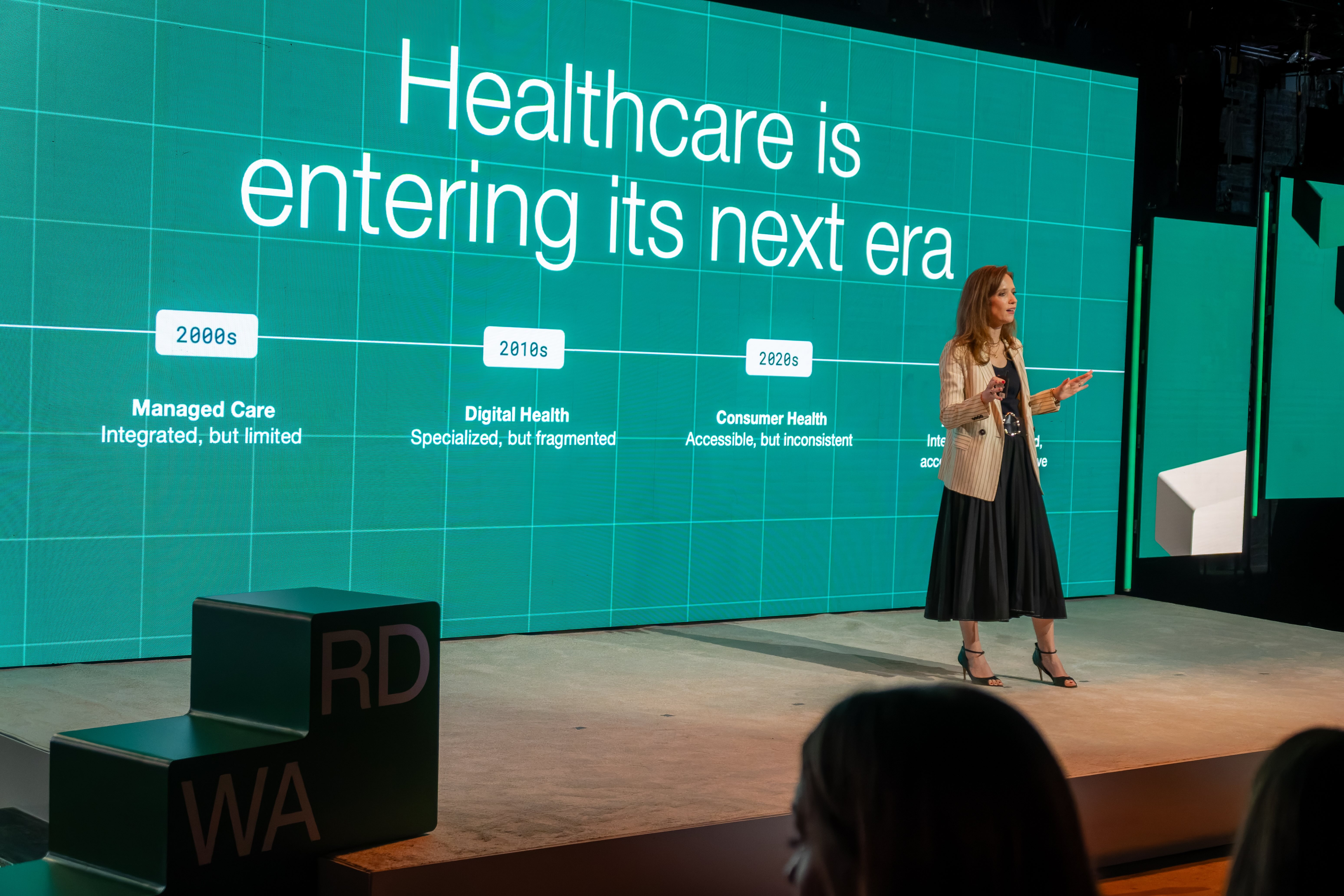

When Maven was founded 12 years ago, telehealth meant a nurse on the phone. Today, 86% of doctors and patients access care digitally, up from 15% in 2019, according to the CDC. That shift has helped Maven grow from a beta product — initially marketed by fliers handed out in New York City parks — to a platform that touches 28 million lives.
That expansion has run parallel with the emergence of digital health and AI — in fact, one in four adults uses AI for health information, and of that group, 14% have skipped a provider visit based on advice they received from AI, according to Gallup. For Maven founder and CEO Kate Ryder, ensuring that members have access to quality virtual care remains a top priority, a goal that can only be reached by establishing trust.
“We can see first-hand the negative impact of access gaps. And with AI and dramatically improved member-level intelligence, there is now so much we can do to cover those gaps, methodically and affordably,” Ryder said at Maven’s first annual Onward conference. “As care becomes more intelligent, outcomes will only get better if you retain trust. Getting this right makes the rest of your work, and the rest of your healthcare benefits design, more effective. Getting it wrong has consequences everywhere else.”
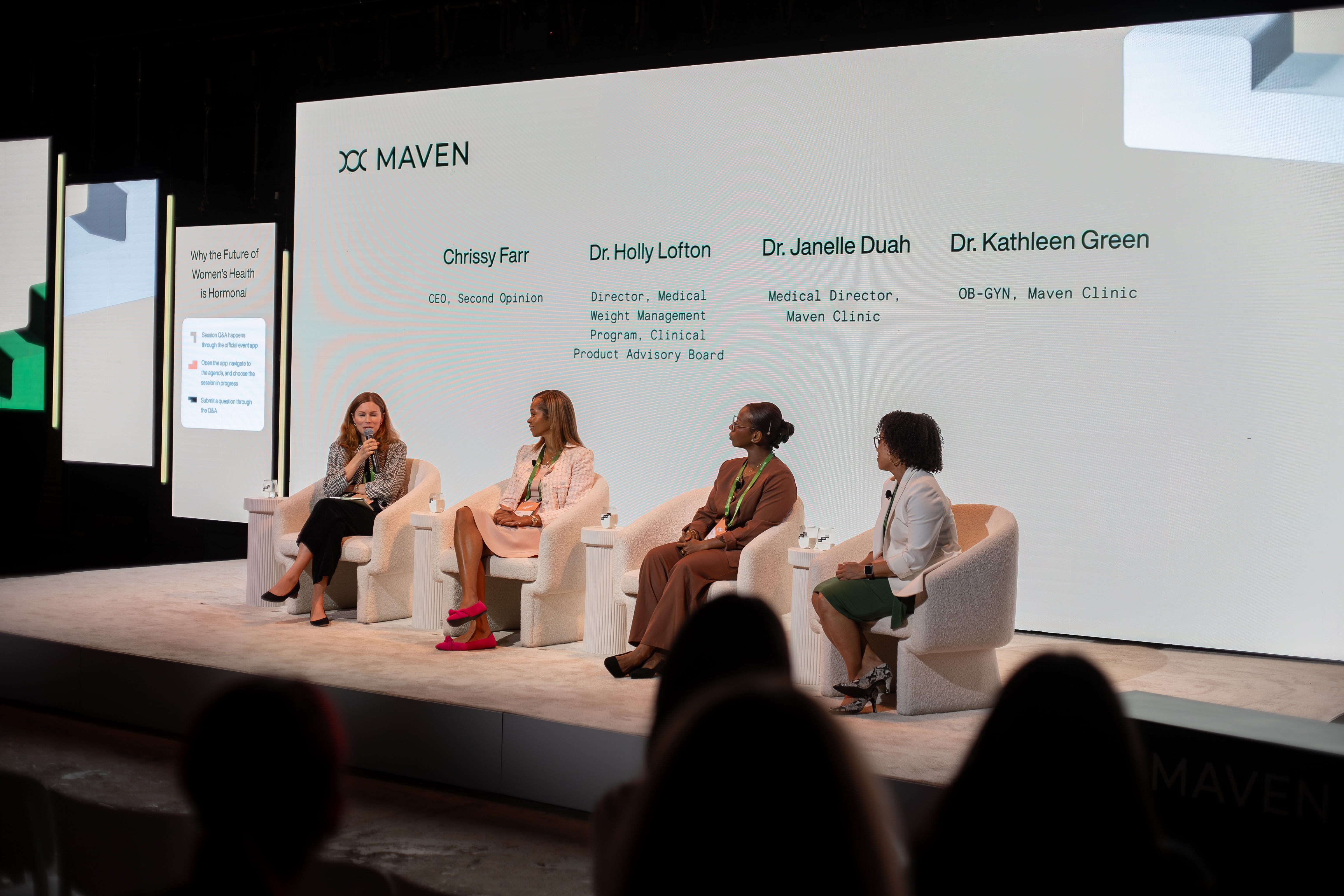
On September 30, Maven hosted Onward, its inaugural conference in New York City. The event brought together HR and benefits leaders, the physicians and founders building the next generation of women's healthcare, and real Maven members sharing their own stories. In addition to discussions about how technology and barriers to access in traditional care are impacting patient behaviors, leaders also discussed ROI measurement frameworks, the value of intelligent care, and what a true platform model looks like.
Trend 1: It’s time to rethink ROI in women's health
Healthcare costs have climbed roughly 10% a year for three years running, and maternity costs are outpacing that. It's about to get more complicated: in January 2027, the AMA is retiring the global OB billing code, moving maternity from one bundled rate to itemized, complexity-based billing.
More granular billing means more visibility into what's actually driving costs. It also means more volatility, unless someone is coordinating the full episode of care.
In a session on measuring ROI in women's health, Christa Moss, Maven's SVP of Clinical Outcomes and Research, argued for rethinking how ROI gets measured in the first place. The framework requires some key shifts:
- Measure the episode, not the year. For maternity, that means looking beyond a calendar-year snapshot and instead at pregnancy through the first year postpartum.
- Include the full picture. In maternity, that means both the baby and the birthing parent — because newborn and NICU costs alone can account for a large share of total episode spend.
- Risk-adjust, always. The members who engage most with a benefit are often the ones who need it most. Without adjusting for that, you'll undersell the value of the care you offer.
Trend 2: Shifting from “more data” to “intelligent care”
While many organizations have successfully found the way to access more data, the new shift is toward intelligent care, where AI and clinical expertise work together to turn data-driven health signals into earlier action.
At Onward, Maven previewed new additions to its own platform, including a Fertility Navigator that surfaces next steps for members trying to conceive, and a Hypertension Pathway that enables more proactive care for high-risk pregnancies.
The value of intelligent care was also a throughline during conversations on predictive and genomic science on stage, where panelists discussed how fields like embryo selection and preeclampsia are finally moving from a “black box” to something data can inform.
Dr. Jeremy Grushcow, CEO and Co-Founder of Juniper Genomics — which uses genetic testing to help identify which embryos are most likely to result in a successful pregnancy — explained it this way: “It's not the mom. It's not the lab. It's not the clinician. It's just [the complexity on] the embryonic level.”
Grushcow explained that with access to deeper data about what embryos are likely to succeed, doctors are better able to explain to patients why their fertility journey is “not going the way they thought it was going to go — and give them permission to stop blaming themselves.”
Dr. Maneesh Jain, CEO and Co-Founder at Mirvie, whose blood test can predict a patient's risk of pregnancy complications like preeclampsia months in advance, made a similar point: when a risk assessment relies on broad demographic factors, doctors hesitate to act on it and patients rarely follow through. But when patients get an objective, biology-based risk result instead, that changes almost immediately. Jain pointed to adherence rates above 90% once someone has a concrete, individualized result to act on.
The intelligent, data-driven model utilized in cancer care also surfaced as a model that can inform approaches to other fields in medicine, including women’s health. Oncology has already built a standard that includes early screening, coordinated care, and long-term follow-up. Now, other fields are catching up.
Trend 3: Platforms work better together
As benefits leaders sift through various point solutions and platform options, they’re also figuring out which vendors are a genuine platform, and how to ensure your benefits work together seamlessly.
Maven spoke alongside their platform partners Color Health and Wellthy to share how they integrate their expertise to provide a seamless care experience for their members. Color Health is a virtual cancer care platform, and Wellthy supports family caregivers navigating everything from aging parents to children with complex medical needs. Both partner to create an integrated experience with Maven to cover care outside its own specialty, rather than leaving members to find it themselves.
When care is truly integrated between vendors, support happens more quickly. That’s critical when a patient needs fertility care fast after a cancer diagnosis, said Othman Laraki, CEO of Color Health. In a moment where "time is lost" too easily, he said, that kind of direct handoff between care teams "can make a very big difference about the course of a person or a family's life."
Lindsay Jurist-Rosner, CEO of Wellthy, believes that kind of coordination shouldn't be the employee's job to figure out. "It's on us to stitch together" care across partners, she said, "not on an employer, and not on employees to figure out where they need to go for what at the right time."
Trend 4: Benefits must be built for life chapters, not clinical events
Throughout the day, a key throughline emerged: while traditional healthcare is built around transactions — a check-up, a delivery, an ER visit — that’s not how people experience their health. The need for preconception support will one day morph into someone seeking care for their high-risk pregnancy. After the pregnancy comes the need for parenting and pediatric support. A benefit that resets at each transition asks members to start over right when they need continuity most.
GLP-1s are the clearest current example of a need that cuts across those chapters instead of living in just one. The same hormonal and metabolic science touches fertility, pregnancy, and menopause, which means a benefit that only addresses one life stage is already behind where the science is headed.
Alexandra Charles, a Maven member for over three years, expected to use the platform for one thing and found it followed her well past that. "I've gone through a lot of the different tracks, from trying to conceive to fertility to parenting," she shared during a panel of Maven members speaking about their own experience on the platform. "Even though you think you're only going to use it for one area, it will follow you through."
On the same panel, Maven Care Advocate and Maven member Apoorva Joshi lived with endometriosis for over a decade before finding care that treated it as more than individual symptoms to manage. "The more doctors I went to, everybody started saying that pain is normal, you should deal with it," she said — to the point that she started to believe "maybe it is all in my head."
What changed, she said, was finally getting "a whole care team available to me" — an OB/GYN, a nutritionist, and a mental health provider working together, "like all the Avengers assembled for me."
The value of one platform, built for trust
As Maven founder Kate highlighted at Onward, the goal isn't more tools, or another app for another symptom. It's one platform — one place where a woman's health history lives and grows with her, from her first period to her last hot flash, where every provider who touches her care actually knows her story, and where AI does the work of connecting it, instead of leaving her to do it herself.
Any woman. Anywhere. Able to find the right care the first time she looks for it — not just for one condition or one life stage, but for all of it, all at once, all the time.
LaCrea Burns, a Maven member who navigated breast cancer treatment and perimenopause at the same time, put it simply: finishing treatment — whether it’s for cancer, in her case, or for any other medical event — isn't the finish line. "You graduate from all these specialties, and [with Maven] you're blessed to have someone who says, actually, now you have more work to do," she said. "This is when the real work happens."
That's the shift happening across women's and family health care right now: moving from reactive, one-and-done benefits to intelligent, full lifecycle care that keeps working long after the initial diagnosis, treatment, or life event.
If your organization is navigating rising costs, a growing list of disconnected vendors, or benefits that end right when your employees need continuity most, contact Maven to learn more about how data-driven, continuous care can make an impact.
Ready to get started with Maven?
See how Maven can support working families, retain talent, and reduce costs



.jpg)

.jpg)

.jpeg)