Olivia Munn's mammogram was clear. So was her ultrasound. And yet, in 2023, the actor and advocate was diagnosed with breast cancer.
“I got my yearly mammogram and an ultrasound because I have dense breasts, and then I had clear genetic testing, and my doctor said, your lifetime risk assessment score is high. We should get an MRI,” Munn shared last month at Onward, Maven’s inaugural conference. “I didn't know what that was — the Tyre Cusick Lifetime Risk Assessment Test. It is a test that takes minutes to take. It's free. It's online, and it will give you a score that tells you how likely you are to have breast cancer in your lifetime. Anything above 20% is considered high risk.”
Munn’s score: 37.3%. Describing why so many standard procedures missed the tumors, she shared, “With dense breasts, there’s extra tissue — imagine we're looking at the sky, and it's a cloudy day. Your tissue and your tumors are all clouds. When you do an MRI, it's a blue sky, and there's one cloud. That's the tumor.”
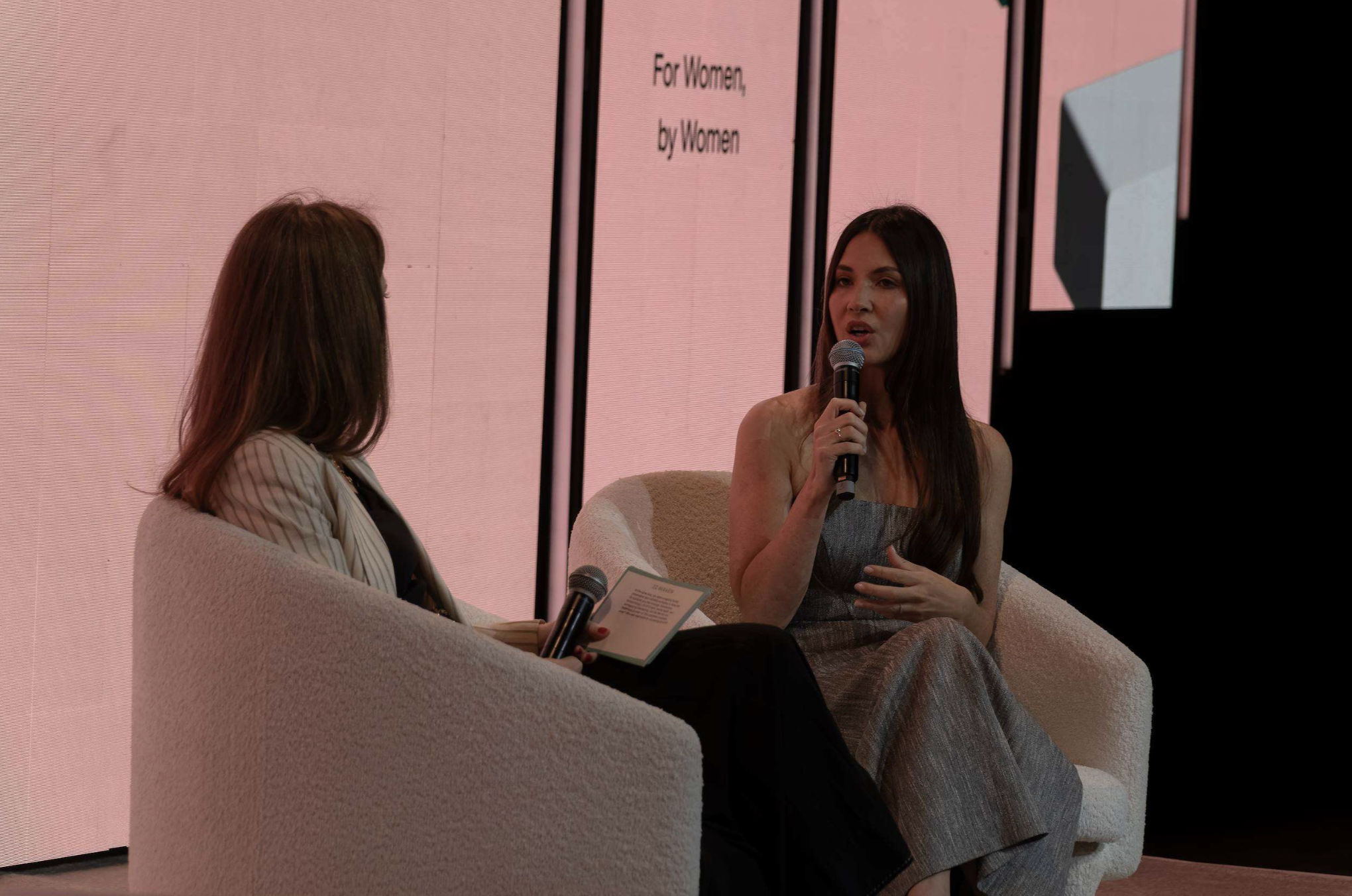
Navigating the series of tests, procedures, treatments and health decisions was overwhelming, Munn said, and seemed like a fragmented health journey when it should have been interconnected. While treating her cancer, Munn was also navigating fertility preservation and, eventually, surrogacy to have her second child, her daughter Mei — oncology, reproductive endocrinology, OB-GYN care, and mental health support, all running in parallel.
"They all felt like five separate journeys happening at the same time, but cancer is not separate from fertility, and fertility is not separate from mental health and family building. It was all one thing,” Munn said.
Despite the physical, mental and emotional challenges, Munn said it was critical for her to stay strong, especially for her son, Malcolm.
“I was focused, and I knew that's what my son needed,” she said. “It was not a time for me to collapse. It was not a time for me to cry. I needed to get through this.”
Connecting the dots with the right care team
Having a team of support was crucial for understanding how to manage multiple conditions. Finding a doctor that could “connect those dots” was something that eventually “saved my life,” Munn said.
"Having her put it all together for me is what saved my life.”
“It was my doctor, Dr. Alibadi, who connected the dots for me and put that all together. It’s incredibly important... because as women, we're often not going in for one issue, and when there are multiple issues, we're just sent off into this mechanism of healthcare and have to become the experts of our own health. So having her put it all together for me is what saved my life.”
That expectation on women to speak up and know how to navigate the complexities of the healthcare system can feel frustrating, Munn said, especially when women are continuously encouraged to advocate for themselves.
"Why are we chastising women for not putting our health first?" Munn said. "When people tell us to advocate, what does that mean? I keep asking for help. I go to my doctor. I try to get the appointment. They tell me I can come back in eight months. What am I supposed to do?”
Streamlining that experience is what Maven was built for: connecting fertility, oncology, maternity, and mental health care under one accountable care team, instead of leaving patients to hold the full picture together themselves. That kind of coordinated care model is why Maven delivers up to $9,600 in savings per birth and 27% lower NICU admission rates, with a 2.6x–5.1x clinical and business ROI — connected, earlier care, rather than a crisis.
Postpartum challenges need guidance, too

Well before her cancer diagnosis, Munn was navigating another challenging and isolating postpartum experience. After struggling to breastfeed her newborn son, she abruptly stopped after two months. The hormonal shifts left her reeling, she said.
“I began an incredibly arduous journey of postpartum anxiety. I heard about depression. I was ready for that. This one came from left field," she said. “Even the little bit of breast milk I was able to make allowed my hormones to stay at a certain level, and I was not aware that if I stopped, everything would just collapse. I'd wake up at 4 a.m. and my eyes would pop open. I would hold my breath, and then eventually, it would just stay in my chest, and I would go through the day like that every single day, morning and night, for a whole year.”
She kept her anxiety mostly hidden, alongside consuming fears she didn’t share with her doctor or even her family. What made it worse wasn't the anxiety itself, but the silence around it.
"No one was just asking, ‘Hey, how are you feeling?’ Even if you're saying I'm fine, I'm fine — there should be someone who knows to just ask me,” Munn said. “It wasn't until I started talking about it, after I'd come out of it, that my psychiatrist said, 'This is what happens when you stop [breast feeding].' I had no idea I did that to myself, because I didn't know about it."
Encouraging other women to speak up
Munn encouraged all women to keep “pounding the door” when they need help and support. Utilizing a platform like Maven can help close knowledge and access gaps — pairing 24/7 access to mental health specialists with the same obstetric and lactation support new parents already rely on, so a hormonal shift after stopping breastfeeding doesn't go unnoticed. It's part of why 94% of Maven's Maternity members return to work after their leave, supported throughout the postpartum period.
Munn said women should turn to their doctors — and each other — when it comes to talking about their health and well-being.
“I think the biggest thing is for us to continue having conversations and to continue encouraging each other, encouraging our friends, our girlfriends, our mothers, our sisters, our daughters, our wives to just just keep pounding the doors until they open,” she said. “Don't stop. Don't ignore anything.”
Read more from Onward:
- Metabolic health, ROI, and the role of AI in healthcare: 4 trends shaping the next decade of women's health
- How Maven, Color, and Wellthy create real platform integration to support the full spectrum of care needs
- How GLP-1s fit into a more connected approach to women’s and metabolic health
- How continuity of care changed the healthcare experience for these Maven members
- How L’Oréal, Microsoft, NWSL and UTA support employees through every life stage
Ready to get started with Maven?
See how Maven can support working families, retain talent, and reduce costs